Reflection
It was mt first time studying research methods. At first, I thought this course is must to do project, but then one thing came to my mind was why do I need to learn philosophical topics for project work. Still I learned what Lars taught us and it became interesting day by day. In initial lectures, I was little reserved to participate in class discussions but eventually I started to participate in group discussions and found it interesting as it gives kind of a confidence to share your knowledge to someone else.
Before doing this course, I was not aware of some important aspects like APA referencing, and copyright licencing etc. I got to learn much more from Lars, who is our tutor for research methods.
Also, there is an appreciation for the work we were doing week by week. Now, we all have a choice whether to do project or to select workplace for next semester. But I guess it can be decide later. As this course has taught so many interesting facts I feel that there should be more couple of lectures to attend of this course. but anyways, it is the first finishing course of my level-7 program. Last but not the least, I would like to thank our amazing tutor Lars Dam.
Ethical Behavior
This week class was all about discussing on different situations and decide whether this kind of behavior is ethical according to you or not and think of possible solutions.
Following are the given circumstances we discussed about in the lecture.
- You find some good images on the web that would look good on your site. You copy and paste them to your blog.
Copying useful image from web, most of the classmates thinking was it is fine to do but not without giving the reference. According to me as well, imprint an image from online content is not unethical if you give a proper reference and do not portray it as it is your own creation. So the solution for this is make sure that everyone going to access your blog can get to know by the referencing that it is not your own creation, it is just used to give a better understanding.
- You are in a hurry to finish an assignment and you find the perfect explanation of a difficult concept on wikipedia. You decide to copy it into your work.
To me, this situation is quite similar to the above situation. In the first circumstance, you are going to use the image from web and in here, it is about completing the assignment by the help of using wikipedia. Wikipedia is like online encyclopedia for multiple purposes. It contains a lot of information so it is quite difficult to find exactly the perfect explanation for any topic whether it is difficult or easy. So, there is no point of passing a judgment on it. But then also if you find precise justification of strenuous idea, it is unethical to directly copy it into assignment as assignments are given for a reason that you learn something from it or at least will try to understand it better. After that the person is supposed to write that into own words by explaining what it is, how it works, why to use this / that, etc.
Solution : The best solution to me time-management. If you start working on your assignments , you will have enough time to work on it and will be able to finish it off within the given timeline without having to copy the content from Wikipedia.
- You are a medical researcher and you think you have discovered a new drug that cures lung cancer. It worked well on mice although a few of them died of heart problems. You want to test it on people. You recruit 100 lung cancer patients into your treatment programme. You don’t tell them about the new drug. You treat 50 patients with usual drugs and 50 with the new drug to see which is better.
Being a researcher, I would like to experiment my new discoveries(drugs / medicines) that can cure a dreadful disease and help the society in good health.
According to me, it is unethical to experiment the medicines on patient without giving them entire information. It is like keeping them in dark and fulfilling your desires.
The solution for this is when you approach any patient to experiment a drug on, tell each and every possibility of getting successful and the probable failure. Because you can not ignore that when you tried it on mice some of them died, it might can not work on human. So, when you find someone who is ready for it even after knowing all the possibilities, you can go ahead for treatment.
- You are a researcher looking at the effect of violent computer games on children. You recruit 20 children into your study. Over a month you regularly show them images of violence to see if it has an adverse effect on their behavior. One of the children becomes quite distressed each time and so you stop showing her images and drop her from the study.
It is nor ethical or unethical to me. When you are looking after the effects of any kind of violence and found out that one of the recruited is having negative effect of it either you can drop him from the same or you can try to make out that how can you convert that resentment into something else that could help that student.
- You want to research how easy it is to hack into your organisation’s computer system by persuading people to divulge login and password details. You recruit a small team to ring up key people in the organisation and persuade them to give either their own or their boss’s details.
It is highly unethical to hack that organization’s computer system, where you are working. At first, you should be loyal to the company you are working for. Loyalty, honesty and transparency should be there in any working environment and it must be followed by all the employees for the sake of the organization’s future and for their own futur too.
- You are doing an initial research in area of a town where may bars and pubs are located, to estimate the level of problematic social behavior in the area. your research is independent from the police, because you want to observe their behavior as well. You observe both abusive and violent behavior.
If I was doing this kind of research, I will definitely not inform police as it is my independent research and on top of that I am not a big fan of police community. So, to me it is ethical to keep police in dark for the given circumstances.
But when you think differently, you should inform police before starting the research for your own security as there may be pubs and bars located. So, in most of the cases, you will find violent personalities.
Review about another person area of interest
The task is to give an honest review on fellow classmate’s area of interest by reading their answers and the given possible projects by them. First, I thought Oleg’s choice for project, which is IoT(Internet of Things) is smart choice as it the fastest growing area of IT. But then I saw Sinhara’s area of interest. The topic he stated was like this – I would like to do some research on benchmarking practice to take multiple measurements of throughput or latency in couple of vendor based network switches which proves RFC is capable enough to perform benchmarking
I never heard about such possibility like benchmarking practice for multiple measurement and as he mentioned that he has been working on this from almost 10 years, i would like to have some depth knowledge about it. May be I can be biased on this as I always find the topics interested related to networking because I also would love to become a part of networking team in some large organization. So, at the end, I like both the topics Oleg’s idea of working on IoT and Sinhara’s idea about benchmarking practice.
Usefulness of blogs
Task:
Decide whose blog is most useful to other students – search through the other student blogs, find the one that you think is the most useful to you and write why you think it is useful in your own blog.
For this exercise, I have to give an opinion on others blog writing though I don’t like it much but as its a part of this week’s exercise I am looking at some aspects like the quality of content and the latest one as well, also noticed that most of my classmates have posted for more then one subject blogs, based on that I am going to choose which student’s blogs are more useful for most of us.
I have read some of my classmates blogs (as I am too lazy to read each and every individual blogs , I just went through some selected blogs of them) and came up with these results.
First, let’s talk about Aline’s blogs( just because I admire her work and the time she spends to do that). As she has a background in journalism, the expectations with her opinions and statements will always be on high note. By reading her blogs about each topic discussion every week, you can clearly notice that she does spend enough time to make it more attractive to read. It’s all about Research Methods subject. I thoroughly believe that if you want to understand more about the topics discussed in the class, definitely should choose Aline;s blogs to refer.
Adding to that, next one is about Enterprise Infrastructure(NET701) subject. I would recommend to read Marcellus’s blogs and his blogs are useful for another subject named System Security(SEC602) as I am also doing the same course, I can understand the range of this subject and commenting on that blogs on the bases of usefulness, Marcellus’s blogs are most useful I found for SEC602 course.
In a nut shell, I would recommend Marcellus Christopher’s blogs as highly useful one.
Reading Exercise
This week, our tutor Lars gave us a task to read the academic paper from suitable sources and can be of any topic we want to choose. I selected two different papers from google scholar on server virtualization technology and tried to link them with each other. I don’t know whether i succeed in this but I did get some more depth knowledge of server virtualization.
Following is the answers based on the results found after reading the paper.
A) What is the title and what does the title tell you about the paper?
As I have used two academic papers, the title of the first paper is “ Server Virtualization Architecture and Implementation “. As the title suggests, the paper illustrates about the history of virtualization, what is virtualization, types of virtualization etc. and a title of another academic paper is “ Server Virtualization Technology and its Latest Trends “ which describes the importance of virtualization technology, why to use this technology, and the latest features and functionality provided by server virtualization technology. It also states the Total Cost of Investment which directly effects on Return on Investment.
B) Who is the paper written by and do they seem credible to you?
The paper named “ Server Virtualization Architecture and Implementation “ is written by Daniel Jeff in the year 2009 and the other paper named “ Server Virtualization Technology and its Latest Trends “ is written by Yamamoto Yoshihiko in the year 2008. According to me, the academic paper Server Virtualization Architecture and Implementation written by Daniel Jeff is more credible than Yamamoto Yoshihiko’s Server Virtualization Technology and its Latest Trends. The paper by Daniel Jeff describes the basics of server virtualization and the history of virtualization which is quite satisfying to me as when someone is reading about the virtualization technology for the first time, the reader should get the clear idea of what that technology is all about and the other paper written by Yamamoto Yoshihiko directly focuses on the new functionalities and features of the virtualization technology. Though it is my personal opinion, it can be vary for others.
C) Does it have a helpful abstract? Give reasons for your answer.
The abstract in both the papers is quite similar to me. In these papers, the abstract tells about the impact of virtualization in an organization like Costing, Management, how the virtual machine can be classified, outline about Xen architecture and virtual machine function. Both of them have different reasons why to use server virtualization technology instead of using bare-metal servers.
D) What did the author(s) do in their research, what research approach and what method(s) did they use?
According to me, the Daniels, J. (2009). Server virtualization architecture and implementation. XRDS: Crossroads, The ACM Magazine for Students, 16(1), 8-12. Inductive research approach and qualitative case studies. And Yamamoto, V. Y. O. V. T. (2008). Server virtualization technology and its latest trends. Fujitsu Sci. Tech. J, 44(1), 46-52. has used Deductive research approach and focus group method.
E) Do you think the method(s) they used was appropriate to the question they were asking? Explain why or why not.
I think the methods used by authors, was appropriate to the content they have given because in both the academic papers, the given content has the satisfactory information and gives proper classification of the functionalities and features and everything they have stated in the papers.
F) What results does the paper report?
The academic paper by Daniels, J. (2009). Server virtualization architecture and implementation. XRDS: Crossroads, The ACM Magazine for Students, 16(1), 8-12 gives the result that there is not only virtualization technology as the virtualization technology also has some drawbacks and the organization should always look up for the other technology if one fails and Yamamoto, V. Y. O. V. T. (2008). Server virtualization technology and its latest trends. Fujitsu Sci. Tech. J, 44(1), 46-52 gives the result that the server virtualization technology has a great future as the use of server virtualization is increasing day by day and it also promotes the enhancement of the virtual machine functions by using PRIMEQUEST and PRIMERGY.
G) Was the paper worth reading? Give reasons for your answer.
Yes, the papers are worth reading as each of them describes what exactly I was looking for to make this report on server virtualization. Both the authors have different content for server virtualization and the same conclusion to use virtualization technology. The paper by Daniels Jeff has the description about history of virtualization technology, who actually introduced virtual machine to the IT world, how it started using instead of using other technologies, the types of virtual machine technology with figures to understand it well,
H) Do you believe the results/findings or the paper? Give reasons for your answer.
Yes, as much as I have learned from these papers, I do believe the findings of it. I actually learned some different sides of virtualization technology from these two papers of Daniels, J. (2009). Server virtualization architecture and implementation. XRDS: Crossroads, The ACM Magazine for Students, 16(1), 8-12. and Yamamoto, V. Y. O. V. T. (2008). Server virtualization technology and its latest trends. Fujitsu Sci. Tech. J, 44(1), 46-52.
I) What did you learn from reading the paper?
Before reading these articles I was not aware of each and every aspect covered in these papers, I got to learn some new aspects of server virtualization technology like how virtual machine actually works, about application to mission-critical servers, data dump functions, the strategic plan of implementing server virtualization, why to use virtualization technology, the licensing of virtualization technology etc. So for me, it was a new learning of virtualization after reading these two academic papers and to be honest it was worth reading it.
Narcissistic Exercise
An Exercise about what we are interested in IT.
The IT area subject I have most enjoyed is Networking
The IT area/subject I have least enjoyed is Programming
The IT area/subject I was most interested is in Cloud Computing
The one IT thing I never want to have do again is Java
I chose to study IT because I want to work with Cisco
If I couldn’t study IT I would go for mechanical engineering studies
When I was a kid I wanted to become a pilot
One IT thing I want to know more about is Cisco Networking and Routing
Meta-Analysis(Presentation)
This week was about giving presentation on different topics. Each group had a different topic to explain, our’s was Meta-Analysis. We did some group research on the topic, not so perfect but yes, we gave a good presentation I think.
So, the following points included in presentation: 1. What is Meta-Analysis? Meta-analysis is a quantitative approach for systematically combining results of previous research to arrive at conclusions about the body of research.
- Quantitative: numbers
- Systematic: methodical
- Combining: putting together
- Previous research: what’s already done
- Conclusions: new knowledge
Meta-analysis is an analytical technique designed to summarize the results of multiple studies.

2. Understanding Meta-Analysis.
- Data from contributing studies are held securely on local, study-based computers.
- Analytical commands are sent as blocks of code to request each local computer to undertake an analysis and return summary results that are non-identifying.
- Analyses are performed locally so all data stay at source and does not leave the originating institution.

3. Systematic Review vs Meta-Analysis.
- It is a common misconception that meta-analysis and systematic reviews are the same and the terms are often used interchangeably. While there is substantial overlap between the two.
- A meta-analysis is a statistical procedure for combining numerical data from multiple separate studies.
- Here is the link to understand the difference between Meta-Analysis and Systematic Review : https://www.youtube.com/watch?v=04E8JiXY2s4
4. Where is it useful? It is useful for the following purposes:
- Summarize and integrate results from a number of individual studies
- Analyze differences in the results among studies
- Increase precision in estimating effects
- Determine if new studies are needed to further investigate an issue
- Generate new hypotheses for future studies.
5. Advantages & Disadvantages of Meta-Analysis. Advantages:
Conceptually, a meta-analysis uses a statistical approach to combine the results from multiple studies in an effort to increase power (over individual studies). Basically, it produces a weighted average of the included study results and this approach has several advantages:
- Results can be generalised to a larger population.
- The precision and accuracy of estimates can be improved as more data is used. This may increase the statistical power to detect an effect.
- It Provides more objective appraisal of the evidence than traditional nerrative reviews.
- Hypothesis testing can be applied on summary estimates.
Disadvantages:
- Poor quality of included studies :A well-done meta-analysis of badly designed studies will yield invalid results.
- Publication bias : It is the phenomenon where studies that showed no effect or were not statistically significant are not likely to be published and therefore do not appear in meta-analyses, which sometimes only search the published literature. Publication bias is likely to lead to overestimation of the true effect in meta-analysis.
6. Example of Meta-Analysis in IT-Research.
We gave an example of PowerBI desktop to show the use of Meta-Analysis in IT-Research. Using Power BI tool, it helps to convert complex data into simple and user friendly visual display. This data can be published online and shared to other users for review. So basically, it makes the data simpler and easier to understand.
At last, Lars asked us for another example of meta-analysis use. So, to answer that, it is also used in clinical-trials now-a-days.
Computational Thinking & Virtualization Technology
Computation Thinking: Computational thinking describes the processes and approaches we draw on when thinking about how a computer can help us to solve complex problems and create systems. We often draw on logical reasoning, algorithms, decomposition, abstraction, and patterns and generalization when thinking computationally.
1st sources of evidence
- Search term used : Computational Thinking
- How you found it : Searching on internet(Google & Google Scholar).
- who wrote it : Australian Government Department of Education
- What kind of publication: Educational
- How Credible: I deem that it is credible more than 80% as it does not only describes the terms but it also contains topic wise elaboration which makes the understanding of the topic easy.
2nd source of evidence
- URL : https://www.youtube.com/watch?v=C2Pq4N-iE4I
- Search Term used: Computational Thinking
- How you found it : You Tube
- Who Uploaded it : Jeannette M. Wing
- What kind of Publication : You Tube Video
- How Credible : According to me it is a credible about 89% as Jeannette M. Wing has done research in this. By watching this video it is quite simple to understand computational thinking and also the CAS(Computing At School) has added this to their conference keynotes. there is a pdf also available by Jeannete Wing. https://www.microsoft.com/en-us/research/wp-content/uploads/2012/08/Jeannette_Wing.pdf
3rd source of evidence
- URL : https://en.wikipedia.org/wiki/Computational_thinking
- Search Term used for : Computational Thinking
- How you find it : Searching on Google
- Who uploaded it : Multiple Experts & Users ,29th August 2019
- What kind of Publication : Computer Science Portal
- How Credible : I think it is 80% credible as wikipedia is one of the most used website worldwide and provide the knowledge in simpler manner.
2. Virtualization Technology:
Virtualization is the process of creating a software-based, or virtual, representation of something, such as virtual applications, servers, storage and networks. It is the single most effective way to reduce IT expenses while boosting efficiency and agility for all size businesses.
1st source of evidence:
- URL : https://www.techopedia.com/definition/26645/intel-virtualization-technology-intel-vt https://www.vmware.com/solutions/virtualization.html
- Search term used : Virtualization Technology .
- How you found it : Searching in Techopedia & Google
- who wrote it and when: VMWare -2019
- What kind of publication: VMware Ofiicial Website & Techopedia(Technology related website).
- How Credible: I think it is 95% because these are the official websites for technology updates and knowledge.
2nd source of evidence:
- URL : https://www.youtube.com/watch?v=FZR0rG3HKIk
- Search term used : Virtualization Technology
- How you found it : YouTube
- who uploaded it : VMWare -2019
- What kind of publication : IBM YouTube video
- How Credible: It is 90% credible as IBM is an American Multinational IT Company dedicated to virtualization mostly in cloud computing.
3rd source of evidence:
- URL : https://www.tutorialspoint.com/virtualization2.0/virtualization2.0_tutorial.pdf
- Search Term Used : Virtualization Technology
- How you find it : Googling & Searching in TutorialsPoint
- Who wrote it & when? : By Tutorial Points Experts
- What kind of Publication? : Study Tutorials
- How Credible : I am used to use this website for study in different subjects. I find it 99% helpful for the studies.
Paradigms
- What is Paradigm? Across disciplines (and within) there are varying views of what research is and how this relates to the kind of knowledge being developed. Paradigms guide how we make decisions and carry out research. Lawyers, for example, will use an adversarial paradigm while selection committees will use a judgmental paradigm (Guba 1990). Your own discipline will also be guided by a paradigm and through the research papers you read in your subject, you will begin to identify, through the methodology the kind of paradigm that is used. As a researcher, it is important to know where your discipline belongs, that there are different ways of viewing the world and that your approach to knowledge is one of many. The following concepts, in boxes, illustrate some of the different approaches to research. Classic Scientific Paradigm:
The paradigm can be define as “a pattern or model, an exemplar; a typical instance of something, an example”.
- what is to be observed and scrutinized
- the kind of questions that are supposed to be asked and probed for answers in relation to this subject
- how these questions are to be structured
- what predictions made by the primary theory within the discipline
- how the results of scientific investigations should be interpreted
- how an experiment is to be conducted, and what equipment is available to conduct the experiment. Research Paradigm:
A research paradigm is “the set of common beliefs and agreements shared between scientists about how problems should be understood and addressed” (Kuhn, 1962)
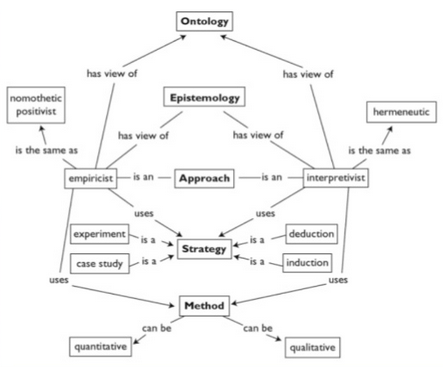
According to Guba (1990), research paradigms can be characterised through their:
- ontology – What is reality?
- epistemology – How do you know something?
- methodology – How do you go about finding it out?
The diagram below explains the above terms and the relationship between them:

I believe each research project would have a different research paradigm and hence a different theoretical perspective.

Ontology & Epistomology
- What is Ontology? How is it relevant to Research? Ontology is associated with a central question of whether social entities should be perceived as objective or subjective. Accordingly, objectivism or positivism and subjectivism can be specified as two important aspects of ontology. In simple words, Ontology and epistemology are two different ways of viewing a Research Philosophy.research can be defined as “the science or study of being” and it deals with the nature of reality. Ontology is a system of belief that reflects an interpretation by an individual about what constitutes a fact. Objectivism “is an ontological position that asserts that social phenomena and their meanings have an existence that is independent of social actors” . Subjectivism (also known as constructionism or Interprevitism) on the contrary, perceives that social phenomena are created from the perceptions and consequent actions of those social actors concerned with their existence. Formally, constructionism can be defined as “ontological position which asserts that social phenomena and their meanings are continually being accomplished by social actors”. Ontology of Research Philosophies: Identification of ontology at the start of the research process is critically important as it determines the choice of the research design. the following figure illustrates the consequent impact of ontology on the choice of research methods via epistemology, research methods and strategy of data collection and data analysis.
2. What is Epistemology? How is it relevant to Research? Having Thought of Ontological Positions, the researcher must then consider Epistemology of his/her work. The Epistemology is about the information that counts as acceptable knowledge and how it should be acquired and interpreted. Epistemology constitutes valid knowledge. Epistemology in a business research as a branch of philosophy deals with the sources of knowledge. Specifically, epistemology is concerned with possibilities, nature, sources and limitations of knowledge in the field of study. Alternatively, epistemology can be branded as the study of the criteria by which the researcher classifies what does and does not constitute the knowledge. In simple words, epistemology focuses on what is known to be true. It is a way of thinking opposite to ontology.
In research philosophy there are many different sources of knowledge. Sources of knowledge related to business research in particular can be divided into the following four categories:
1. Intuitive knowledgeis based on intuition, faith, beliefs etc. Human feelings plays greater role in intuitive knowledge compared to reliance on facts.
2. Authoritarian knowledge relies on information that has been obtained from books, research papers, experts, supreme powers etc.
3. Logical knowledge is a creation of new knowledge through the application of logical reasoning.
4. Empirical knowledge relies on objective facts that have been established and can be demonstrated.

3. What is the connection between ontology and epistemology in research ?
Epistemology is the study of the ways we receive and interpret information from the world. It deals with whether an objective reality exists, how we know our perception of it is accurate, and the ways that informs what we know.
Ontology, on the other hand, is the study of existence and being. It’s primarily concerned with identity and the self.

First Blog Posting
- What do you think ‘research is? Research is a process of systematic inquiry that entails collection of data; documentation of critical information; and analysis and interpretation of that data/information, in accordance with suitable methodologies set by specific professional fields and academic disciplines.
- Do you think you will ever need research skills? We all research, even if we don’t know it. Research skills are the ability to search for, find, collect, analyse, interpret and evaluate information that is relevant to the subject being studied. Research skills are important as its pivotal in studies and business too. I think, I need to improve my research skills to catch up with the latest industrial methods of conveying the knowledge.
- What do you think a research journal is and who is it written for? Research journal is a systematical record, usually written, that is kept by a researcher for the purpose of observing and reflecting on phenomena relevant to a particular research study. It provides a genuine platform for the researchers, academicians and students around the globe to share knowledge in the form of high quality research work in all the subjects and cover the fields of Life sciences, health sciences, physical sciences, earth sciences, chemical sciences, library and information sciences, education, management and engineering . Research Journal is one place where one can sense the quality of research ideas. With open access and peer review feature, Interdisciplinary research/review work can be submitted for publication. Only unpublished and novel work is considered for publication with an aim to create quality research environment around the world. It publishes only after performing plagiarism test using quality plagiarism testing tools so that novelty and quality of submitted manuscript is judged at first level. Through this online journal worldwide research community gets the chance to communicate and synchronize their research activities leading to growth and application of research and technology.


 NMIT's Blog Assignment
Great to finally see your work – well done 🙂
LikeLike
You did a great jonb in presentation 🙂
LikeLike
thank you
LikeLike
Nice
LikeLike
thank you
LikeLike
Good last posting – try to put them in as separate postings 🙂
LikeLike
yeah sure, thank you for pointing it out
LikeLike